-
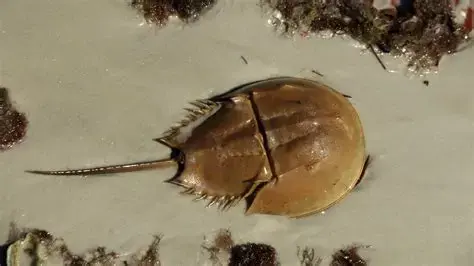
Horse shoe crabs are “living fossils” meaning they have existed nearly unchanged for at least for 445 million years, well before even dinosaurus existed.
-
There are four species of horseshoe crab still around today. Only one species, Limulus polyphemus is found in North America along the Atlantic and gulf coasts from Maine to Mexico. The other three species are found in southeast Asia.
-
Horseshoe crabs have a tank like a structure consisting of a front shell called prosoma, a back shell called the opisthosoma and spike like tail called ‘Telsen’.
-
Their body structure is extremely effective for survival, think, if it ain’t broke, don’t fix it.
-
Horseshoe crabs are also extremely important to the biomedical industry because they are unique, copper based Blue blood contains a substance called “Limulus Amebocyte Lysate”, or “LAL”.
-
This compound coagulates or clump up in the presence of a small amount of bacterial toxins and is used for to test for sterility of medical equipment and virtually all injectable drugs. That way, when you get a you know it hasn’t been contaminated by any bacteria.
In the literature
PubMed and arXiv
- PubMed2020Editorial: EvoDevo research in Asia.Su YH, Ota KG · Evolution & developmentRead the paper
- PubMed2022Microscopic marine invertebrates are reservoirs for cryptic and diverse protists and fungi.Holt CC, Boscaro V, Van Steenkiste NWL · MicrobiomeRead the paper
- PubMed2022What is the difference between marine and limnetic-terrestrial associations of nematodes with invertebrates?Tchesunov AV, Ivanenko VN · Integrative zoologyRead the paper
- PubMed2024Diversity and function of fluorescent molecules in marine animals.Poding LH, Jägers P, Herlitze S · Biological reviews of the Cambridge Philosophical SocietyRead the paper
Matched automatically on this article’s subjects. Relevance varies — these are suggestions for further reading, not sources for the piece above.
Sign in to save articles and join the discussion.