-
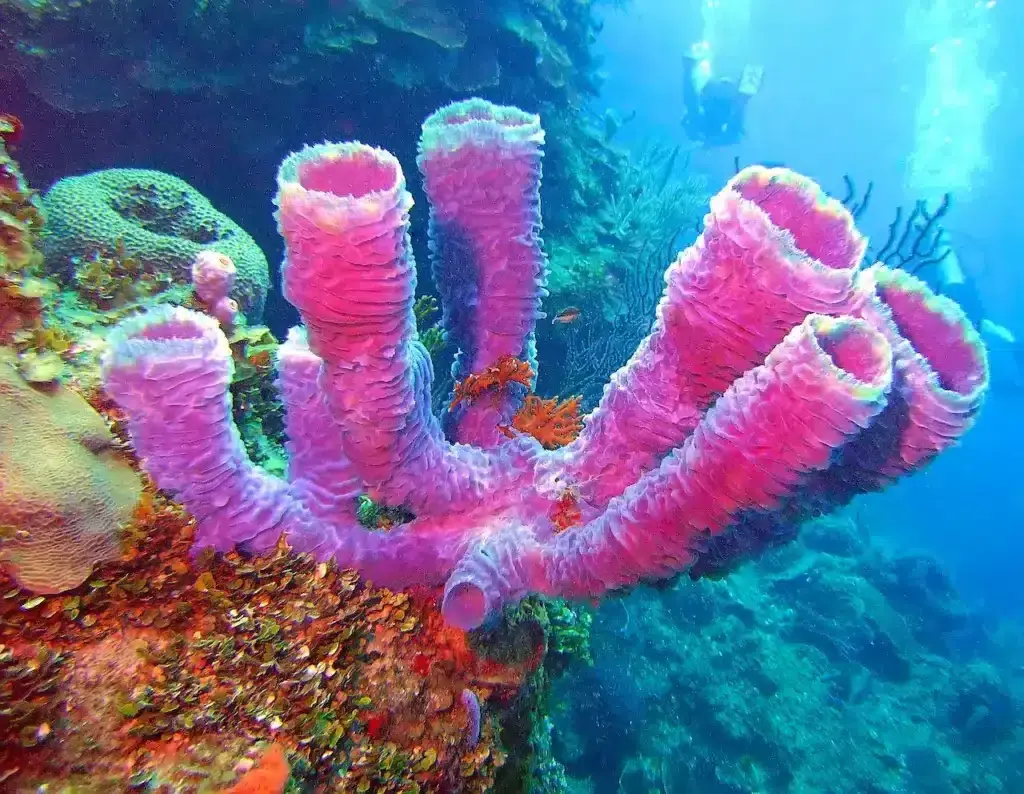
Commonly known as SPONGES.
-
Generally marine
-
Mostly ASYMMETRICAL ANIMALS
-
Primitive multicellular animals
-
CELLULAR LEVEL OF ORGANISATION.
-
Sponges have a water transport or canal system.
-
Water enters through minute pores (ostia) in the body wall
-
A central cavity, SPONGOCOEL
-
Water goes out through the osculum.
-
Choanocytes or collar cells line the spongocoel and the canals.
-
Digestion is intracellular.
-
A skeleton made up of SPICULES OR SPONGIN FIBRES.
-
Sexes are not separate (hermaphrodite).
Sponge Predators
In general, sponges aren’t very tasty to most other marine animals. They can contain toxins, and their spicule structure probably doesn’t make them very comfortable to digest. Two organisms that eat sponges though are hawksbill sea turtles and nudibranchs. Some nudibranchs will even absorb a sponge’s toxin while it eats it and then use the toxin in its own defense.
Examples:
- Sycon (Scypha),
- Spongilla (Fresh water sponge)
- Euspongia (Bath sponge)
In the literature
PubMed and arXiv
- PubMed2014Microbial communities and bioactive compounds in marine sponges of the family irciniidae-a review.Hardoim CC, Costa R · Marine drugsRead the paper
- PubMed2022Promising antiparasitic agents from marine sponges.Mostafa O, Al-Shehri M, Moustafa M · Saudi journal of biological sciencesRead the paper
- PubMed2017The sponge microbiome project.Moitinho-Silva L, Nielsen S, Amir A · GigaScienceRead the paper
- PubMed2023Microbiome diversity from sponges biogeographically distributed between South America and Antarctica.Freitas MAM, Cunha-Ferreira IC, Leal CV · The Science of the total environmentRead the paper
Matched automatically on this article’s subjects. Relevance varies — these are suggestions for further reading, not sources for the piece above.
Sign in to save articles and join the discussion.