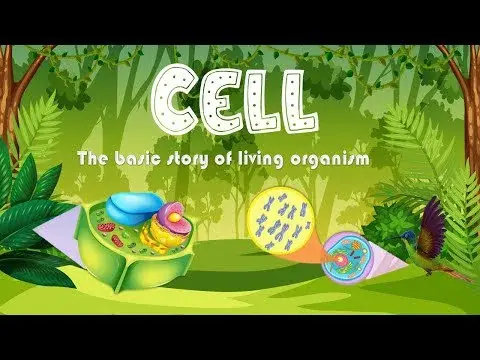
The cell as we know it is the basic structural and functional unit of life, or we can call it the basic morphological and physiological unit of the body. If we try to understand the difference between prokaryotic and eukaryotic cells, their structure, components and their functions then it will be a bit difficult to understand. So, we will try to understand it with an example or story.
Suppose a man is starting a business or a company. He will be the owner or boss of that company. So he rented the space like a big hall and in it he installed the necessary machines for production. He hired some workers to operate the machine and pack the product. The master will be among them and will instruct the workers, assign them work and manage them. At this stage or time, will the boss have a separate and large luxurious cabin for him? Will it have a separate power house for that company? Will it have a production and packing unit with an automated and advanced system? The answer would be no. Since they have started a new company, they will not have much money to cover a large area with large production, packing, power house and an automated and advanced systems. At this stage, he will have only one room with machines and few workers.
Now suppose that after a few years, this company developed and became a big company. Now it will have all those things. The boss will have a separate and big luxurious cabin. There will be a circle of security around him. No one can contact him directly. For each job there will be a separate department that will handle or manage that work. There will be a separate production unit, packing unit and power house. There will be a canteen for food. Automated and advanced machines. There will be a security cordon around important departments.

Now let's apply the concept of the story to prokaryotic and eukaryotic cells. Like a company, when a cell is a primitive (prokaryotic cell), it has only one boss, the molecule, and the machines, the ribosome. Will it have a subsidiary i.e. Histone Proteins like a company? Will it have a separate cabin i.e. nucleus? Will it have layers of protection i.e. membrane? Will it have a powerhouse i.e. mitochondria? Will it have canteen i.e. chloroplast? Will it have a separate packaging unit i.e. Golgi complex? Will it have advanced organelles? The answer would be, no. There will be no such things in it. Since the cell is in the primitive state like the company, it will not have such organelles.
Now let's discuss the eukaryotic cell in the context of a large and developed company. Like a developed company, it will have all those advanced things. Now the boss will have a separate chamber i.e. nucleus. Surrounding it will be layers of protection, that is, a double membrane around the nucleus. One can no longer directly interact with DNA. There will be separate departments for each task i.e. different organelles for different tasks. There will be a separate production unit, packing unit and power house i.e. ribosome, Golgi complex and mitochondria. There will be a canteen i.e. chloroplast for food. There will be a transport system i.e. endoplasmic reticulum. The units that remove waste and toxic materials will be lysosomes and peroxisomes. There will be a security cover around the important organelles. Now cell has become bigger and more advanced like the company, which means cell is more evolved than before.
That's the difference between prokaryotic and eukaryotic cells, their structure, components and their functions.
References
Resolved via Crossref
- 01Creation of a Bacterial Cell Controlled by a Chemically Synthesized Genome
Daniel G. Gibson, John I. Glass, Carole Lartigue, Vladimir N. Noskov, Ray-Yuan Chuang, Mikkel A. Algire +18 more · Science · 2010
10.1126/science.1190719
In the literature
PubMed and arXiv
- PubMed2011A decade of molecular cell biology: achievements and challenges.Akhtar A, Fuchs E, Mitchison T · Nature reviews. Molecular cell biologyRead the paper
- PubMed2018Protein Phase Separation: A New Phase in Cell Biology.Boeynaems S, Alberti S, Fawzi NL · Trends in cell biologyRead the paper
- PubMed2025Towards multimodal foundation models in molecular cell biology.Cui H, Tejada-Lapuerta A, Brbić M · NatureRead the paper
- PubMed2012Cell biology 2.0.Lim WA, Alvania R, Marshall WF · Trends in cell biologyRead the paper
Matched automatically on this article’s subjects. Relevance varies — these are suggestions for further reading, not sources for the piece above.
Sign in to save articles and join the discussion.