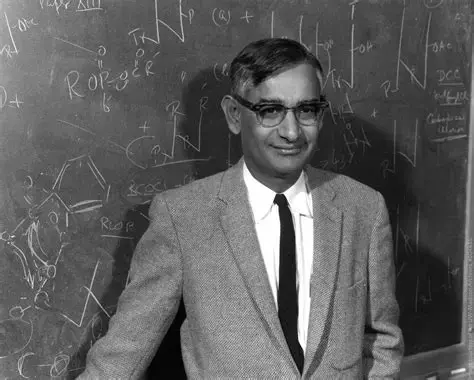
Har Gobind Khorana was born of Hindu parents in Raipur,a little village in Punjab, which is now part of eastern Pakistan. From the boy who started his primary education studying from a village teacher under a tree to a world renowned biochemist, his life was one long eventful journey. The man who formed a part of the team which successfully deciphered the genetic code — the mother of all codes. He was the first person to demonstrate the role of nucleotides in . In 1968 the Nobel Prize in Physiology or Medicine was awarded jointly to Har Gobind Khorana, Robert W. Holley, and Marshall W. Nirenberg "for their interpretation of the genetic code and its function in protein synthesis"
Biography
Khorana was born to Krishna Devi Khorana and Ganpat Rai Khorana, in Raipur, a village in Multan, Punjab, British India in a Punjabi Hindu family. The exact date of his birth is not certain but he believed that it might have been 9 January 1922; this date was later shown in some documents, and has been widely accepted. He was the youngest of five children. His father was a patwari. In his autobiography, Khorana wrote this summary: "Although poor, my father was dedicated to educating his children and we were practically the only literate family in the village inhabited by about 100 people."
He started his primary education studying from a village teacher under a tree. He went to the D.A.V High School in Multan where he was greatly influenced by his teacher, Ratan Lal. He earned a scholarship to study chemistry at the Punjab University, Lahore. He completed his B.Sc in 1943 and M.Sc in 1945.
A brilliant student, he was awarded a scholarship by the Government of India to study at the University of Liverpool. He received his PhD in 1948 advised by Roger J. S. Beer.
During a brief period in 1949, he was unable to find a job in his original home area in the Punjab.
He returned to England on a fellowship to work with George Wallace Kenner and Alexander R. Todd on peptides and nucleotides. He stayed in Cambridge from 1950 until 1952.
He received a job offer from Dr. Gordon M Shrum of the University of British Columbia, Vancouver, in 1952. He accepted even though the British Columbia Research Council did not offer many facilities for research. His work in British Columbia was on "nucleic acids and synthesis of many important biomolecules".
In 1960 Khorana accepted a position as co-director of the Institute for research at the Institute for Enzyme Research at the University of Wisconsin at Madison. During the 1960s he delved deeper into his experiments in nucleic acids found in , a chemical that translates the genetic information contained in . RNA is composed of four chemical bases represented by the letters A, C, U, and G. He showed that the genetic code consisted of 64 distinct three-letter words. Biochemist Marshall W. Nirenberg had independently been working on genetics and Khorana confirmed the former’s findings that four different types of nucleotides are arranged on the spiral staircase of the DNA molecule. He proved that the nucleotide code is transmitted in groups of three called "codons" to the cells. RNA with two repeating units (UCUCUCU → UCU CUC UCU) produced two alternating amino acids. Using chemical synthesis to combine the chemical bases, Khorana deduced that the code for serine was UCU and for leucine it was CUC. RNAs with three repeating units (UACUACUA → UAC UAC UAC or ACU ACU ACU or CUA CUA CUA) produced three different strings of amino acids. RNAs with four repeating units including UAG, UAA, or UGA, produced only dipeptides and tripeptides thus revealing that UAG, UAA, and UGA are stop codons. And he proved that some codons are responsible for signaling to the cells to start or stop the manufacture of .
In 1968 the Nobel Prize in Physiology or Medicine was awarded jointly to Har Gobind Khorana, Robert W. Holley, and Marshall W. Nirenberg "for their interpretation of the genetic code and its function in protein synthesis".
He became the Alfred Sloan Professor of Biology and Chemistry at the Massachusetts Institute of Technology (MIT) in 1970 and remained there till his retirement in 2007. Khorana was the first scientist to chemically synthesize oligonucleotides.
In 1972, he successfully constructed the world's first synthetic . A few years later he made the artificial gene function in a bacteria cell. Subsequent scientists referred to his research while advancing editing with the / system. He extended the above to long DNA polymers using non-aqueous chemistry and assembled these into the first synthetic gene, using polymerase and ligase enzymes that link pieces of DNA together as well as methods that anticipated the invention of polymerase chain reaction (PCR). These custom-designed pieces of artificial genes are widely used in biology labs for sequencing, cloning and engineering new plants and animals, and are integral to the expanding use of DNA analysis to understand gene-based human disease as well as human evolution. Genetic engineering has been made possible only due to the ability to synthesize DNA.
After the middle of the 1970s, his lab studied the biochemistry of bacteriorhodopsin, a membrane protein that converts light energy into chemical energy by creating a proton gradient. He experimented on the molecular mechanisms underlying the cell signaling pathways of vision in vertebrates. He primarily studied the structure and function of Rhodopsin, a light sensitive protein found in the eye.
Har Gobind Khorana died on 9 November 2011, in Concord, Massachusetts, at the age of 89. He is now not with us but his works and achievements will always remain with human race.
Watch his biography: https://player.vimeo.com/video/678992591?h=f97245d4b3
References
Resolved via Crossref
- 01Total synthesis of the gene for an alanine transfer ribonucleic acid from yeast
H. G. Khorana · Pure and Applied Chemistry · 1971
10.1351/pac197125010091
In the literature
PubMed and arXiv
- PubMed2017Russia's new Lysenkoism.Kolchinsky EI, Kutschera U, Hossfeld U · Current biology : CBRead the paper
- PubMed2014Anu Suomalainen.Suomalainen A · Current biology : CBRead the paper
- PubMed2024Notes from Beethoven's genome.Wesseldijk LW, Henechowicz TL, Baker DJ · Current biology : CBRead the paper
- PubMed2018James Watson at 90.Pederson T · FASEB journal : official publication of the Federation of American Societies for Experimental BiologyRead the paper
Matched automatically on this article’s subjects. Relevance varies — these are suggestions for further reading, not sources for the piece above.
Sign in to save articles and join the discussion.