🧬 2025 Nobel Prize in Physiology or Medicine
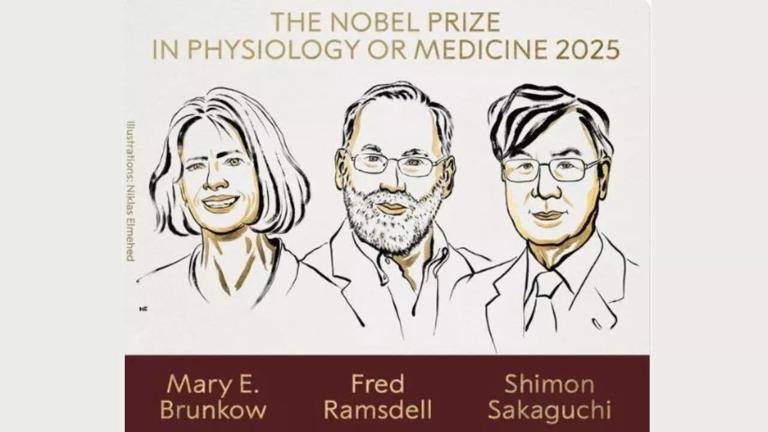
Honoring: Mary E. Brunkow, Fred Ramsdell, and Shimon Sakaguchi
Three scientists — Mary E. Brunkow (USA), Fred Ramsdell (USA), and Shimon Sakaguchi (Japan) — have won the 2025 Nobel Prize in Physiology or Medicine for discovering how our immune system prevents attacking our own body, a process known as peripheral immune tolerance.
🛡️ The Immune System: Your Body’s Defense Force
Your works like a security team, defending you from:
- Bacteria
- Cancer cells
- Other harmful invaders
The Key Players: T Cells
T cells are specialized white blood cells — the immune system’s soldiers. There are two main types:
- Helper T cells – act like scouts, detecting threats and alerting others
- Killer T cells – act like enforcers, destroying infected or abnormal cells
Each T cell has a unique receptor on its surface — like a lock designed to fit a specific invader’s key. Your body can generate trillions of these receptors, giving it remarkable adaptability against new diseases.
⚔️ The Problem: When the Body Attacks Itself
Sometimes T cells get confused and target healthy tissues, leading to autoimmune diseases, such as:
- Rheumatoid arthritis
- Type 1 diabetes
- Lupus
This “friendly fire” is what immune tolerance aims to prevent.
🧠 Immune Tolerance: Teaching the Immune System Peace
Immune tolerance is how the body trains the immune system to recognize “self” (your own cells) and attack only “non-self” (invaders).
Two Levels of Tolerance
1. Central Tolerance
- Occurs in the thymus gland (behind the breastbone)
- Immature T cells are trained here
- T cells that react to the body’s own tissues are removed early
2. Peripheral Tolerance
- Occurs throughout the rest of the body
- Acts as a backup system
- Controls any self-reactive T cells that escape thymic screening
The 2025 Nobel winners uncovered how peripheral tolerance works — a fundamental discovery for immunology.
🕊️ The Breakthrough: Regulatory T Cells (Tregs)
The scientists identified special cells called regulatory T cells, or Tregs.
What Do Tregs Do?
Tregs are peacekeepers of the immune system. They:
- Suppress overactive immune responses
- Prevent autoimmunity
- Help shut down immune activity after infections
- Keep the body from staying in “fight mode” too long
How to Recognize Tregs
Tregs carry distinctive surface :
- CD4
- CD25
These markers help scientists identify them under a microscope.
🧬 The Master Switch: The Foxp3 Gene
The Foxp3 gene is the master control for Tregs.
What Foxp3 Does
- Directs cells to become regulatory T cells
- Produces a protein crucial for Treg function
- Maintains immune balance by ensuring Tregs work properly
When Foxp3 Fails
If the Foxp3 gene is mutated or missing:
- Tregs can’t develop
- The immune system turns against the body
- Severe inflammation and autoimmune diseases occur
👩🔬 Individual Contributions
Shimon Sakaguchi – Discovering the Peacekeepers
1980s, Japan: Sakaguchi removed the thymus from mice — they developed autoimmune diseases. When he reintroduced specific T cells, the diseases disappeared.
1995: He identified these protective cells as regulatory T cells (CD4⁺, CD25⁺). His work revived the long-dismissed concept of “suppressor cells” and sparked a new field of research.
Mary E. Brunkow & Fred Ramsdell – Finding the Gene
1990s, United States: Studying mysterious “scurfy” mice that suffered severe autoimmune issues, they traced the cause to a mutation on the X chromosome.
Their discoveries:
- Mapped the faulty to Foxp3
- Showed that defective Foxp3 prevents Treg formation
- Linked the to a human disorder — IPEX syndrome (Immune dysregulation, Polyendocrinopathy, Enteropathy, X-linked)
IPEX patients suffer from severe autoimmune diseases early in life, attacking intestines and hormone-producing organs.
(Historical note: The “scurfy” mouse line originated from 1940s radiation experiments at Oak Ridge, Tennessee.)
🌍 Why This Discovery Matters
🧫 Cancer Therapy
- Problem: Tregs can protect by suppressing immune attacks.
- Solution: Drugs that block Tregs temporarily can help the immune system destroy cancer cells more effectively — enhancing immunotherapy.
🧩 Autoimmune Disease Treatment
-
Problem: Too few Tregs cause autoimmunity.
-
Solution: Therapies aim to boost Treg activity, using methods such as:
- Low doses of interleukin-2
- Expanding Tregs in the lab
💉 Treg Cell Therapy
How it works:
- Collect Tregs from a patient’s blood
- Grow or modify them in the lab
- Reinfuse them into the patient
Potential applications:
- Preventing organ transplant rejection
- Treating multiple sclerosis
- Treating graft-versus-host disease
- Calming autoimmune inflammation
Many are underway — offering targeted, long-lasting immune control with fewer side effects than traditional immune-suppressing drugs.
🏁 Summary
The 2025 Nobel Prize in Physiology or Medicine honors groundbreaking discoveries that revealed:
- Regulatory T cells (Tregs) — the body’s immune peacekeepers
- The Foxp3 gene — the master switch that creates and controls Tregs
- Peripheral immune tolerance — the mechanism that prevents immune self-destruction
These discoveries transformed our understanding of:
- Autoimmune diseases
- Cancer immunotherapy
- Organ transplant tolerance
- Immune system balance
The work of Brunkow, Ramsdell, and Sakaguchi continues to shape modern medicine, bringing us closer to curing autoimmune diseases and designing better cancer vaccines.
🧾 Key Terms
| Term | Meaning |
|---|---|
| Autoimmune disease | When the immune system attacks healthy tissues |
| CD4/CD25 | Proteins that mark regulatory T cells |
| Foxp3 gene | Gene controlling Treg development |
| Immune tolerance | The immune system’s ability to avoid attacking self |
| Interleukin-2 | Protein that promotes Treg growth |
| Peripheral tolerance | Immune regulation outside the thymus |
| Regulatory T cells (Tregs) | Cells that prevent autoimmunity |
| Thymus | Organ where T cells are trained |
💬 What do you think? Could this discovery pave the way for cures to lupus, diabetes, or even better cancer ? Share your thoughts below!
References
Resolved via Crossref
- 01Immunologic self-tolerance maintained by activated T cells expressing IL-2 receptor α-chains (CD25). Breakdown of a single mechanism of self-tolerance causes various autoimmune diseases
S Sakaguchi, N Sakaguchi, M Asano, M Itoh, M Toda · The Journal of Immunology · 1995
10.4049/jimmunol.155.3.1151 - 02Disruption of a new forkhead/winged-helix protein, scurfin, results in the fatal lymphoproliferative disorder of the scurfy mouse
Mary E. Brunkow, Eric W. Jeffery, Kathryn A. Hjerrild, Bryan Paeper, Lisa B. Clark, Sue-Ann Yasayko +4 more · Nature Genetics · 2001
10.1038/83784
In the literature
PubMed and arXiv
- PubMed2015Human autoimmune diseases: a comprehensive update.Wang L, Wang FS, Gershwin ME · Journal of internal medicineRead the paper
- PubMed2024Transforming vaccinology.Rappuoli R, Alter G, Pulendran B · CellRead the paper
- PubMed2019Nobel prize for medicine 2019 and the impact of cytometry.Tárnok A · Cytometry. Part A : the journal of the International Society for Analytical CytologyRead the paper
- PubMed2024The next Nobel Prize in chemistry or in physiology or medicine.Kadoch C, Sheltzer JM, Yin H · Cell chemical biologyRead the paper
Matched automatically on this article’s subjects. Relevance varies — these are suggestions for further reading, not sources for the piece above.
Sign in to save articles and join the discussion.