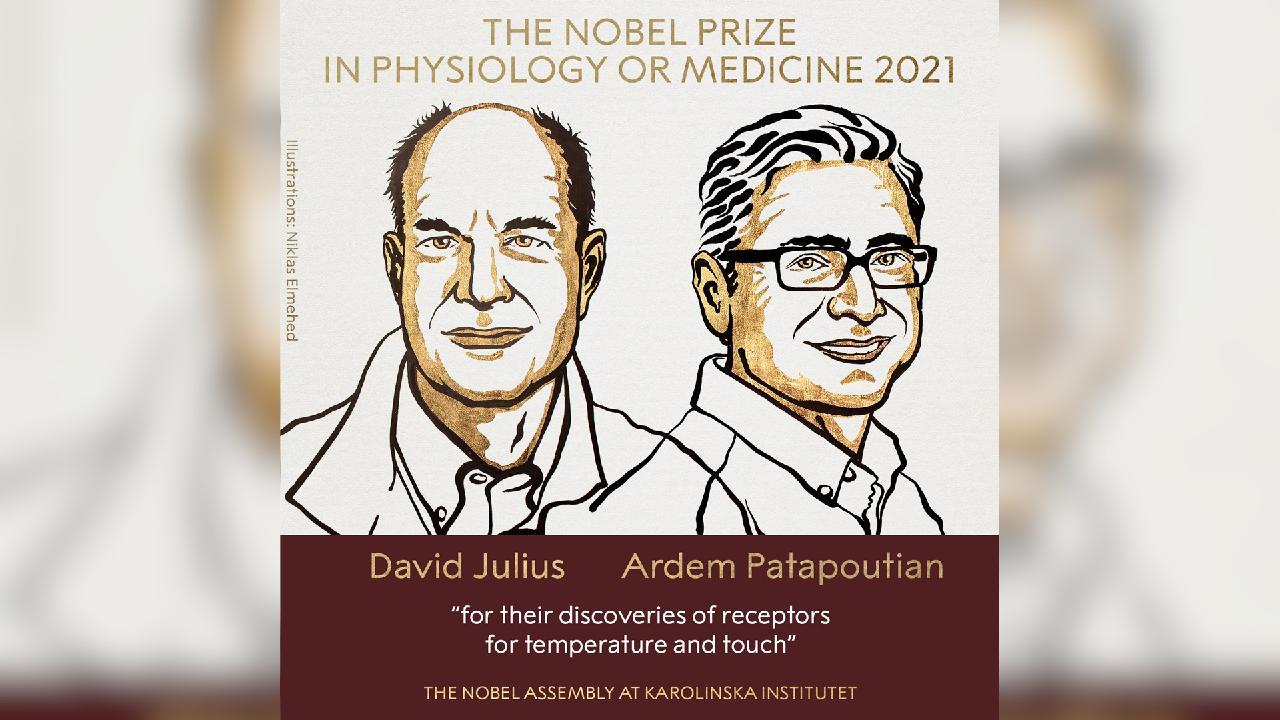
Our ability to sense heat, cold and touch is essential for survival and underpins our interaction with the world around us. In our daily lives we take these sensations for granted, but how are nerve impulses initiated so that temperature and pressure can be perceived? This question has been solved by this year’s Nobel Prize Laureates.
David Julius utilized capsaicin, a pungent compound from chili peppers that induces a burning sensation, to identify a sensor in the nerve endings of the skin that responds to heat. Ardem Patapoutian used pressure-sensitive cells to discover a novel class of sensors that respond to mechanical stimuli in the skin and internal organs. These breakthrough discoveries launched intense research activities leading to a rapid increase in our understanding of how our nervous system senses heat, cold, and mechanical stimuli. The Laureates identified critical missing links in our understanding of the complex interplay between our senses and the environment.
David Julius saw the possibility for major advances by analyzing how the chemical compound capsaicin causes the burning sensation we feel when we come into contact with chili peppers. Capsaicin was already known to activate nerve cells causing pain sensations, but how this chemical actually exerted this function was an unsolved riddle. Julius and his co-workers created a library of millions of fragments corresponding to that are expressed in the sensory neurons which can react to pain, heat, and touch. They expressed individual genes from this collection in cultured cells that normally do not react to capsaicin. After a laborious search, a single gene was identified that was able to make cells capsaicin sensitive. Further experiments revealed that the identified gene encoded a novel ion channel and this newly discovered capsaicin receptor was later named TRPV1. When Julius investigated the protein’s ability to respond to heat, he realized that he had discovered a heat-sensing receptor that is activated at temperatures perceived as painful. The discovery of TRPV1 was a major breakthrough leading the way to the unravelling of additional temperature-sensing receptors.
David Julius’ discovery of TRPV1 was the breakthrough that allowed us to understand how differences in temperature can induce electrical signals in the nervous system.
While the mechanisms for temperature sensation were unfolding, it remained unclear how mechanical stimuli could be converted into our senses of touch and pressure.
Ardem Patapoutian wished to identify the elusive receptors that are activated by mechanical stimuli. Patapoutian and his collaborators first identified a cell line that gave off a measurable electric signal when individual cells were poked with a micropipette. It was assumed that the receptor activated by mechanical force is an ion channel and in a next step 72 candidate genes encoding possible receptors were identified. After an arduous search, Patapoutian and his co-workers succeeded in identifying a single gene whose silencing rendered the cells insensitive to poking with the micropipette. A new and entirely unknown mechanosensitive ion channel had been discovered and was given the name Piezo1. Through its similarity to Piezo1, a second gene was discovered and named Piezo2. Sensory neurons were found to express high levels of Piezo2 and further studies firmly established that Piezo1 and Piezo2 are ion channels that are directly activated by the exertion of pressure on cell membranes. The breakthrough by Patapoutian led to a series of papers from his and other groups, demonstrating that the Piezo2 ion channel is essential for the sense of touch. Moreover, Piezo2 was shown to play a key role in the critically important sensing of body position and motion, known as proprioception.
In further work, Piezo1 and Piezo2 channels have been 5 shown to regulate additional important physiological processes including blood pressure, respiration and urinary bladder control.
The groundbreaking discoveries of the TRPV1, TRPM8 and Piezo channels by this year’s Nobel Laureates have allowed us to understand how heat, cold and mechanical force can initiate the nerve impulses that allow us to perceive and adapt to the world around us. The TRP channels are central for our ability to perceive temperature. The Piezo2 channel endows us with the sense of touch and the ability to feel the position and movement of our body parts. TRP and Piezo channels also contribute to numerous additional physiological functions that depend on sensing temperature or mechanical stimuli. This knowledge is being used to develop treatments for a wide range of disease conditions, including chronic pain.
References
Resolved via Crossref
- 01The capsaicin receptor: a heat-activated ion channel in the pain pathway
Michael J. Caterina, Mark A. Schumacher, Makoto Tominaga, Tobias A. Rosen, Jon D. Levine, David Julius · Nature · 1997
10.1038/39807 - 02Piezo1 and Piezo2 Are Essential Components of Distinct Mechanically Activated Cation Channels
Bertrand Coste, Jayanti Mathur, Manuela Schmidt, Taryn J. Earley, Sanjeev Ranade, Matt J. Petrus +2 more · Science · 2010
10.1126/science.1193270
In the literature
PubMed and arXiv
- PubMed2020C. elegans: a sensible model for sensory biology.Iliff AJ, Xu XZS · Journal of neurogeneticsRead the paper
- PubMed2022The sorption/chromatography hypothesis of olfactory discrimination: The rise, fall, and rebirth of a Phoenix.Coppola DM · BioEssays : news and reviews in molecular, cellular and developmental biologyRead the paper
- arXiv2017Not peer reviewedNobel Symposium 162 - MicrofluidicsarXiv preprintRead the paper
- arXiv2018Not peer reviewedAdditional contributions from: Nobel Symposium 162 - MicrofluidicsarXiv preprintRead the paper
Matched automatically on this article’s subjects. Relevance varies — these are suggestions for further reading, not sources for the piece above.
Sign in to save articles and join the discussion.