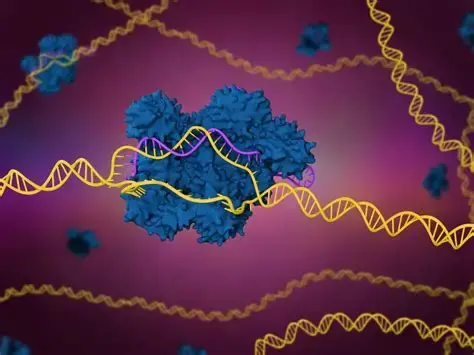
- is a powerful -editing tool that allows scientists to make precise changes to the genetic code of living organisms. CRISPR stands for Clustered Regularly Interspaced Short Palindromic Repeats, which are segments of found in the genomes of bacteria and other microorganisms. The Cas9 is an that can be directed to a specific location in the genome by a guide (gRNA). Together, the CRISPR-Cas9 system allows scientists to cut specific sequences of DNA, delete, insert or replace , and make other changes to the genome with high precision.
CRISPR-Cas9 has rapidly become one of the most widely used and versatile genome-editing tools in the scientific community, with applications in many different areas of biology, including human health, agriculture, and environmental conservation. Some examples of the use of CRISPR-Cas9 include:
- Developing new treatments for genetic diseases by editing disease-causing genes
- Creating genetically modified crops that are resistant to pests and diseases
- Developing gene therapies to cure inherited genetic disorders
- Studying the function of genes and genetic pathways
- Generating animal models of human diseases to study the disease mechanism
- Studying the evolution and diversity of microorganisms
CRISPR-Cas9 is a powerful tool, but also has ethical concerns and concerns about the unintended consequences of editing the genome and its applications. Due to this, scientists and regulators are working together to establish guidelines for the safe and responsible use of CRISPR-Cas9 and other genome-editing technologies.
References
Resolved via Crossref
- 01A Programmable Dual-RNA–Guided DNA Endonuclease in Adaptive Bacterial Immunity
Martin Jinek, Krzysztof Chylinski, Ines Fonfara, Michael Hauer, Jennifer A. Doudna, Emmanuelle Charpentier · Science · 2012
10.1126/science.1225829
In the literature
PubMed and arXiv
- PubMed2017CRISPR/Cas9 Immune System as a Tool for Genome Engineering.Hryhorowicz M, Lipiński D, Zeyland J · Archivum immunologiae et therapiae experimentalisRead the paper
- PubMed2024CRISPR innovations in tissue engineering and gene editing.Razavi Z, Soltani M, Souri M · Life sciencesRead the paper
- PubMed2021Engineered miniature CRISPR-Cas system for mammalian genome regulation and editing.Xu X, Chemparathy A, Zeng L · Molecular cellRead the paper
- PubMed2023CRISPR/Cas9 Landscape: Current State and Future Perspectives.Tyumentseva M, Tyumentsev A, Akimkin V · International journal of molecular sciencesRead the paper
Matched automatically on this article’s subjects. Relevance varies — these are suggestions for further reading, not sources for the piece above.
Sign in to save articles and join the discussion.